
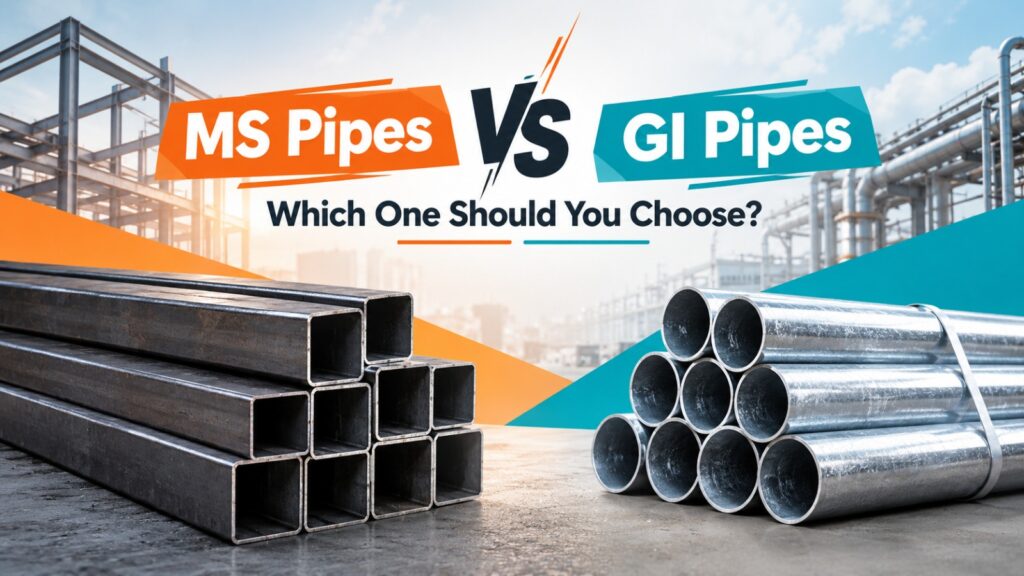
When it comes to selecting the right steel pipe for a construction, infrastructure, fabrication or industrial project, one of the most common questions buyers face is: Should you choose MS pipes or GI pipes?
Both Mild Steel (MS) pipes and Galvanized Iron (GI) pipes are widely used across India. They offer different characteristics, advantages and applications, making the choice largely dependent on the environment, project requirements, budget and expected service life.
Choosing the right pipe is important because the decision can affect not only the initial procurement cost but also maintenance requirements, durability, fabrication and long-term project performance.
While MS pipes are known for their versatility, strength and fabrication suitability, GI pipes are particularly valued for their zinc coating and improved resistance to corrosion.
So, which one is better?
The answer is not as simple as saying one is better than the other. MS pipes and GI pipes are designed for different requirements, and the right choice depends on where and how the pipe will be used.
In this guide, we explain the key differences between MS pipes and GI pipes, their advantages, applications and the factors buyers should consider before making a purchase.
What Are MS Pipes?
MS pipes are pipes made from mild steel, a low-carbon form of steel that is widely used in construction, engineering, manufacturing and fabrication.
Mild steel is popular because it offers a useful combination of strength, ductility, weldability and affordability.
MS pipes are available in different diameters, thicknesses and specifications, allowing them to be used for a wide variety of applications.
They are commonly used in:
- Structural fabrication
- Industrial frameworks
- Construction projects
- Machinery structures
- Fencing
- Agricultural applications
- General engineering
- Manufacturing
- Scaffolding
- Industrial pipelines
- Support structures
One of the major advantages of MS pipes is their ease of fabrication. They can generally be cut, welded, drilled and shaped according to project requirements.
However, untreated mild steel is susceptible to corrosion, particularly when exposed to moisture, humidity or harsh environmental conditions. Depending on the application, MS pipes may therefore require protective treatments such as painting or coating.
What Are GI Pipes?
GI pipes are steel pipes that have been galvanized with a protective layer of zinc.
The galvanizing process is intended to protect the underlying steel from corrosion and extend the pipe’s service life in environments where exposure to moisture is a concern.
The zinc coating acts as a protective barrier between the steel and the surrounding environment. It can also provide additional protection against corrosion when the surface is exposed to atmospheric conditions.
GI pipes are commonly used in applications such as:
- Water supply systems
- Plumbing
- Irrigation
- Agricultural installations
- Fencing
- Outdoor structures
- Construction
- Utility applications
- Certain industrial applications
The primary reason buyers choose GI pipes over conventional MS pipes is generally corrosion protection.
However, that does not mean GI pipes are automatically the right choice for every application. The cost, required dimensions, environment, fabrication requirements and project specifications should all be considered.
MS Pipes vs GI Pipes: Key Differences
The most important differences between MS pipes and GI pipes relate to their surface protection, corrosion resistance, fabrication requirements, cost and applications.
Let’s examine these differences in detail.
1. Material and Surface Treatment
The basic material in both products is steel, but the major difference is surface treatment.
MS pipes are generally supplied as mild steel pipes without a zinc coating. If additional corrosion protection is required, buyers may use paint, protective coatings or other treatments depending on the application.
GI pipes, on the other hand, have a zinc coating applied to the steel surface through the galvanizing process.
This coating provides additional protection against corrosion.
Therefore, the choice between the two often begins with a simple question:
Will the pipe be exposed to conditions where corrosion protection is particularly important?
If the answer is yes, GI pipes may be worth considering.
2. Corrosion Resistance
Corrosion resistance is one of the biggest differences between MS pipes and GI pipes.
Untreated MS pipes can develop rust when exposed to moisture, water or humid environments over time.
This does not necessarily make MS pipes unsuitable for outdoor applications. They can be protected through suitable coatings and maintenance.
GI pipes have an advantage because their zinc coating provides additional protection against corrosion.
This makes GI pipes particularly useful for applications where the pipe may be exposed to:
- Rain
- Humidity
- Moisture
- Outdoor conditions
- Water
- Certain atmospheric environments
However, buyers should remember that galvanization does not make steel completely immune to corrosion. The performance of a GI pipe depends on factors such as coating quality, environmental conditions, mechanical damage and the nature of the application.
3. Durability and Service Life
Durability is another important factor when comparing MS pipes and GI pipes.
A properly selected and maintained MS pipe can provide long-term service. However, in environments where corrosion is a major concern, protective coating and periodic maintenance may be required.
GI pipes can offer an advantage in such environments because the zinc coating provides an additional layer of protection.
For projects where maintenance access is difficult or where replacing pipes frequently would be expensive, corrosion protection may become an important consideration.
This is why buyers should think beyond the initial purchase price.
A product that costs slightly more at the procurement stage may potentially provide better long-term value if it reduces maintenance requirements and protects against premature deterioration.
4. Cost Comparison
Cost is naturally one of the first things considered when purchasing steel pipes.
In general, GI pipes can have a higher initial purchase cost than untreated MS pipes because of the additional galvanizing process.
MS pipes can therefore be attractive for projects where:
- The environment is relatively controlled
- Corrosion exposure is limited
- Protective painting is already part of the project
- Fabrication requirements are significant
- Initial material cost needs to be optimized
GI pipes may justify their higher initial cost when corrosion resistance and reduced maintenance are important.
However, comparing MS and GI pipes purely on their purchase price can be misleading.
A more useful approach is to consider total cost of ownership.
This may include:
Initial pipe cost + transportation + fabrication + installation + coating/painting + maintenance + replacement cost
For a long-term project, the cheapest product at the time of purchase may not necessarily be the most economical solution over its entire service life.
5. Ease of Fabrication
MS pipes are widely used in fabrication because mild steel is generally easy to cut, weld, drill and modify.
This makes MS pipes popular for structural and engineering applications where the pipe needs to be customized during installation.
GI pipes can also be fabricated, but the zinc coating needs to be taken into account during cutting, welding and other fabrication operations.
For example, welding galvanized steel requires appropriate precautions because heating the zinc coating can produce fumes and may damage the coating around the welded area.
After fabrication, the affected area may require suitable repair or protection depending on the application and applicable standards.
Therefore, if a project involves extensive fabrication and welding, buyers should discuss the requirements with their engineers, fabricators and steel supplier before choosing between MS and GI pipes.
6. Appearance
MS pipes typically have the appearance associated with untreated or black steel, while GI pipes have a characteristic zinc-coated surface.
For certain applications, the appearance of galvanized steel may be desirable because it provides a relatively uniform metallic finish.
However, appearance is generally a secondary consideration compared with structural performance, corrosion resistance and technical suitability.
For applications where the pipe will be visible, buyers may also consider painting or other finishing requirements.
7. Weight and Dimensions
It is important to understand that the term “MS pipe” or “GI pipe” alone does not determine the pipe’s dimensions or weight.
Pipe diameter, wall thickness, length and steel specifications all influence the final weight and performance.
A GI pipe with a particular diameter and thickness cannot simply be compared with an MS pipe without considering the actual specifications.
For procurement teams, this means quotations should clearly specify:
- Outside diameter or nominal bore
- Wall thickness
- Length
- Steel grade
- Coating requirements
- Applicable standards
- Quantity
Comparing products based only on the terms “MS” and “GI” can lead to inaccurate cost comparisons.
Where Are MS Pipes Commonly Used?
MS pipes are widely used in construction, fabrication and industrial applications.
Structural Applications
MS pipes can be used for frameworks, supports, industrial structures, sheds and other fabricated structures.
Industrial Fabrication
Manufacturing and engineering businesses often use MS pipes for machinery structures, frames and fabricated components.
Construction
MS pipes can be used in various construction and infrastructure applications depending on the structural design and specifications.
Fencing and Railings
MS pipes are frequently used for gates, railings, fencing and related fabrication.
Agricultural Applications
Depending on the project requirements, MS pipes can be used in agricultural structures, irrigation-related installations and other fabricated applications.
The key advantage is their combination of versatility, availability and fabrication suitability.
Where Are GI Pipes Commonly Used?
GI pipes are particularly useful where corrosion resistance is an important consideration.
Water Supply
GI pipes have historically been used in various water supply and plumbing applications, subject to applicable standards and project requirements.
Irrigation
Their corrosion-resistant coating can make them suitable for certain agricultural and irrigation applications.
Outdoor Structures
GI pipes can be used in applications exposed to outdoor conditions where additional corrosion protection is desirable.
Fencing
Galvanized pipes are often considered for fencing and outdoor frameworks because of their protective coating.
Construction and Utilities
GI pipes can be used in various utility and construction applications depending on the required specifications and standards.
Again, the correct application should always be determined based on engineering requirements rather than simply choosing GI because it is galvanized.
MS Pipes vs GI Pipes: Which Is Better for Construction?
There is no universal answer.
The right choice depends on the specific construction application.
If the pipe is being used in a structural framework where extensive fabrication and welding are required and corrosion exposure is manageable, MS pipes may be a practical option.
If the pipe is going to remain exposed to moisture or outdoor conditions and corrosion protection is a major consideration, GI pipes may be more suitable.
Construction companies should therefore consider:
- Project location
- Exposure to moisture
- Required service life
- Structural requirements
- Fabrication requirements
- Maintenance access
- Budget
- Applicable standards
A qualified engineer or project consultant should determine the technical suitability of the pipe for structural applications.
MS Pipes vs GI Pipes for Outdoor Applications
Outdoor applications require special consideration because pipes can be exposed to rain, humidity, sunlight, pollutants and other environmental factors.
GI pipes can have an advantage in such conditions because the zinc coating provides additional corrosion protection.
MS pipes can also be used outdoors, but they may require suitable protective coatings and periodic maintenance depending on the environment.
For example, an MS pipe used in an outdoor structure may need painting or another protective coating to reduce corrosion.
Therefore, the choice should be based on the expected environment and maintenance strategy.
MS Pipes vs GI Pipes: Which One Is More Economical?
The answer depends on the project.
For projects where the pipe is installed in a relatively controlled environment, MS pipes may provide an economical solution.
For projects where corrosion could result in significant maintenance or replacement costs, GI pipes may offer better long-term value despite a potentially higher initial purchase price.
The right question is therefore not:
“Which pipe is cheaper?”
Instead, buyers should ask:
“Which pipe provides the best overall value for this application?”
This approach considers the initial price as well as maintenance, durability, installation and replacement requirements.
How to Choose Between MS Pipes and GI Pipes
Before making a purchase, buyers should consider the following factors.
1. Understand the Application
Determine exactly where and how the pipe will be used.
2. Assess Environmental Exposure
Consider whether the pipe will be exposed to rain, water, humidity, chemicals or other corrosive conditions.
3. Determine the Required Specifications
Confirm diameter, thickness, length, grade and applicable standards.
4. Evaluate Fabrication Requirements
If significant cutting, drilling or welding is required, discuss the requirements with the fabricator and supplier.
5. Calculate Total Cost
Consider material, transportation, installation, maintenance, coating and potential replacement costs.
6. Consider Maintenance
Ask how easily the installed pipe can be inspected, painted or maintained.
7. Choose a Reliable Supplier
A dependable supplier should be able to provide clear specifications, consistent quality and the required quantity within the agreed timeline.
Why Choosing the Right Steel Pipe Supplier Matters
Even after deciding between MS and GI pipes, another important decision remains: where should you buy them?
The quality and consistency of the product can have a significant impact on project execution.
A reliable steel pipe supplier should be able to provide:
- Clear product specifications
- Consistent quality
- Multiple sizes and dimensions
- Bulk supply capability
- Timely dispatch
- Reliable logistics
- Technical product information
- Competitive pricing
For businesses that regularly purchase steel, working with a supplier capable of supplying multiple products can also simplify procurement.
Naresh Ispat offers a range of tubular steel products, including MS black pipes, GI pipes, square pipes, rectangular pipes and round pipes, along with structural steel products such as beams, channels, angles and bars.
For construction companies, fabricators, manufacturers and industrial buyers, access to multiple steel products through one supplier can help simplify purchasing and project coordination.
Frequently Asked Questions
Are MS pipes better than GI pipes?
Neither is universally better. MS pipes are versatile and suitable for many fabrication and structural applications, while GI pipes provide additional corrosion protection through their zinc coating. The right choice depends on the application and environmental conditions.
Which is cheaper, MS pipe or GI pipe?
MS pipes generally have a lower initial cost because they do not require the galvanizing process. However, GI pipes may provide better long-term value in applications where corrosion protection and reduced maintenance are important.
Which pipe is better for outdoor use?
GI pipes can be advantageous for outdoor applications because their zinc coating provides additional corrosion protection. MS pipes can also be used outdoors when appropriate protective coatings and maintenance are provided.
Can MS pipes be used for water applications?
MS pipes can be used in certain applications, but their suitability depends on the specific water system, engineering requirements, applicable standards and required corrosion protection. The intended application should be evaluated before selecting the product.
Are GI pipes completely corrosion-proof?
No. Galvanization provides additional corrosion protection, but GI pipes can still corrode under certain conditions, particularly if the coating is damaged or the pipe is exposed to aggressive environments.
Can GI pipes be welded?
Yes, GI pipes can be welded, but welding can affect the zinc coating around the weld area and requires appropriate safety precautions and post-weld protection where applicable.
How do I choose the right pipe for my project?
Start by identifying the application, environmental conditions, required dimensions, structural or operational requirements, fabrication needs, expected service life and budget. A reliable steel pipe supplier can also help you understand the available product options.
Choosing between MS pipes and GI pipes is ultimately a matter of matching the product to the application.
MS pipes are widely valued for their versatility, strength, fabrication suitability and cost-effectiveness. They can be an excellent choice for structural, industrial and fabrication applications, particularly where corrosion can be managed through suitable coatings or where the operating environment is relatively controlled.
GI pipes offer an additional advantage through their zinc coating, making them particularly useful in applications where exposure to moisture, humidity or outdoor conditions makes corrosion protection an important consideration.
The best choice therefore depends on several factors, including environment, application, dimensions, fabrication requirements, maintenance expectations, project life and total cost.
For buyers, the goal should not simply be to find the cheapest pipe. The goal should be to select a product that provides the right combination of performance, durability, quality and value over the life of the project.
Whether you need MS pipes for structural fabrication or GI pipes for applications where corrosion protection is important, choosing a dependable supplier is equally essential. With the right product and the right supply partner, businesses can improve procurement efficiency, reduce avoidable project delays and ensure that their steel requirements are met with greater confidence.